
Our good fortune with the elements finally came to an end today, steady showers forestalling any grandiose adventures we might have envisioned. But just as certain activities call for sun, some are perhaps best left for the rain, so we headed out to the city center to grab some groceries for our prolonged stay–an effort aided by relative Erik and the use of his vehicle. While the walk up to our apartment on the hillside provides a great source of daily exercise, it’s not such an enjoyable trek in the rain while carrying several bags of food, so we were grateful for the helping hand.
Later in the day, Erik and his wife, Kari, took us on a short jaunt over to Leikanger, where we met their daughter, Trude; her husband, Bjørn; and their twins, Therese and Kasper. While I have heard many stories already about all of the relatives I have been meeting on this trip, it has been a mentally laborious task to try to piece together the family tree in my own mind. Today was the first time I was able to follow the branches back far enough to understand where I connect to it all, which was an admittedly cool moment.
My father’s great-grandfather, Erik, was one of three brothers, two of whom emigrated to the United States in the latter half of the nineteenth century; Andreas was the other. The third brother, Karl Georg, stayed behind in Norway and was great-grandfather to Erik (of modern day Sogndal and grocery heroics). Accordingly, Trude and I belong to the same generation in the Foss bloodline.
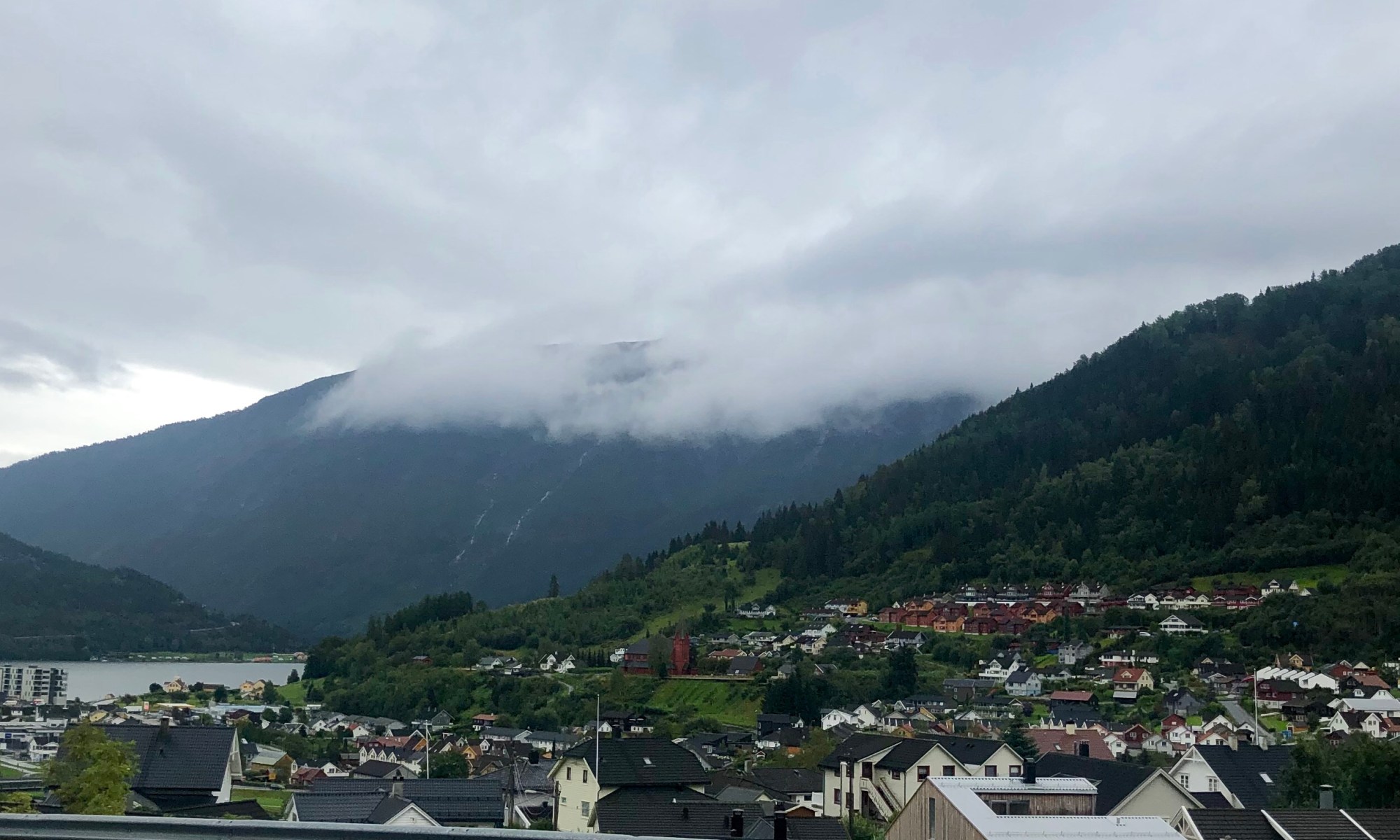
This brings me to the subject I hoped to explore further in this post, since today’s weather offered few opportunities for pictures but encouraged extended contemplation (though, to be fair, Sogndal photographs pretty well even when blanketed in fog).
In the United States, we are currently engulfed in a political storm centered around the subject of immigration. Our president–who holds that title in name alone and certainly not in deed, temperament, or merit–has tapped into the absolute worst demons of our nature to vilify those who come to our country seeking a better life. Several of the people I hold dearest in my life have been directly impacted by his campaign of hatred, and, as a result, while I cannot fully understand the plight they are forced to endure on a daily basis, I have a closer vantage point to witness the devastation his policies are causing than many do.
I have never thought of myself as an immigrant, because I am not one. I was born in the United States, and the government has always considered and treated me as undeniably American as a result of our hateful reliance on skin color as a determinant of one’s belonging. But, of course, as this trip has made clear, if you follow my family’s history back far enough, you can see that I, too, am rooted in at least one story of immigration. (Due to my father’s rigorous scholarship with regard to his ancestry, I am far more familiar with his half of the puzzle.)
And so I sit here in this country that holds so many answers to my origin story, and while I am immensely grateful to have the opportunity to learn about and appreciate where I came from, I am also resolutely angry.
I am grateful for the warm hospitality and sense of immediate welcome that I feel here. I am grateful to be in a country where my name is neither difficult to spell nor to pronounce. I am grateful to know that my family is deeply rooted in the notion that seeking a better life under arduous circumstances should be something that is welcomed, not something we make as terrifying as possible. It is a philosophy that is central to my core belief system, but has not been something I have previously been able to connect so strongly to my own ancestry.
I am angry that our president evoked “immigrants from Norway” in an attempt to juxtapose them against the modern-day immigrants he so loathes, a picayune effort to camouflage his obvious racism; my ancestors left Norway for largely the same reasons of economic hardship that bring many people to the United States today. I am angry that my great-great-grandfather is among those lauded as brave trailblazers for seeking better lives for their families while present-day refugees are criminalized and murdered for doing the same. I am angry that we continue to ground our debate on immigration in falsehoods and scare tactics rather than examinations of the real circumstances that spur migration and the tangible part we continue to play in engendering them.
And so I am conflicted, to say the least. But on this last point, I feel neither gratitude nor anger, only clarity: if we are to make a better world, we must understand our shared human desire for the ability to live fulfilling lives. And we must remember that our own personal fulfillment can never come at the expense of another’s. Until we are all free, none of us is.
 Where the Waterfalls Mean Home
Amen.
I have loved you forever, Steffen and now I am in awe.