
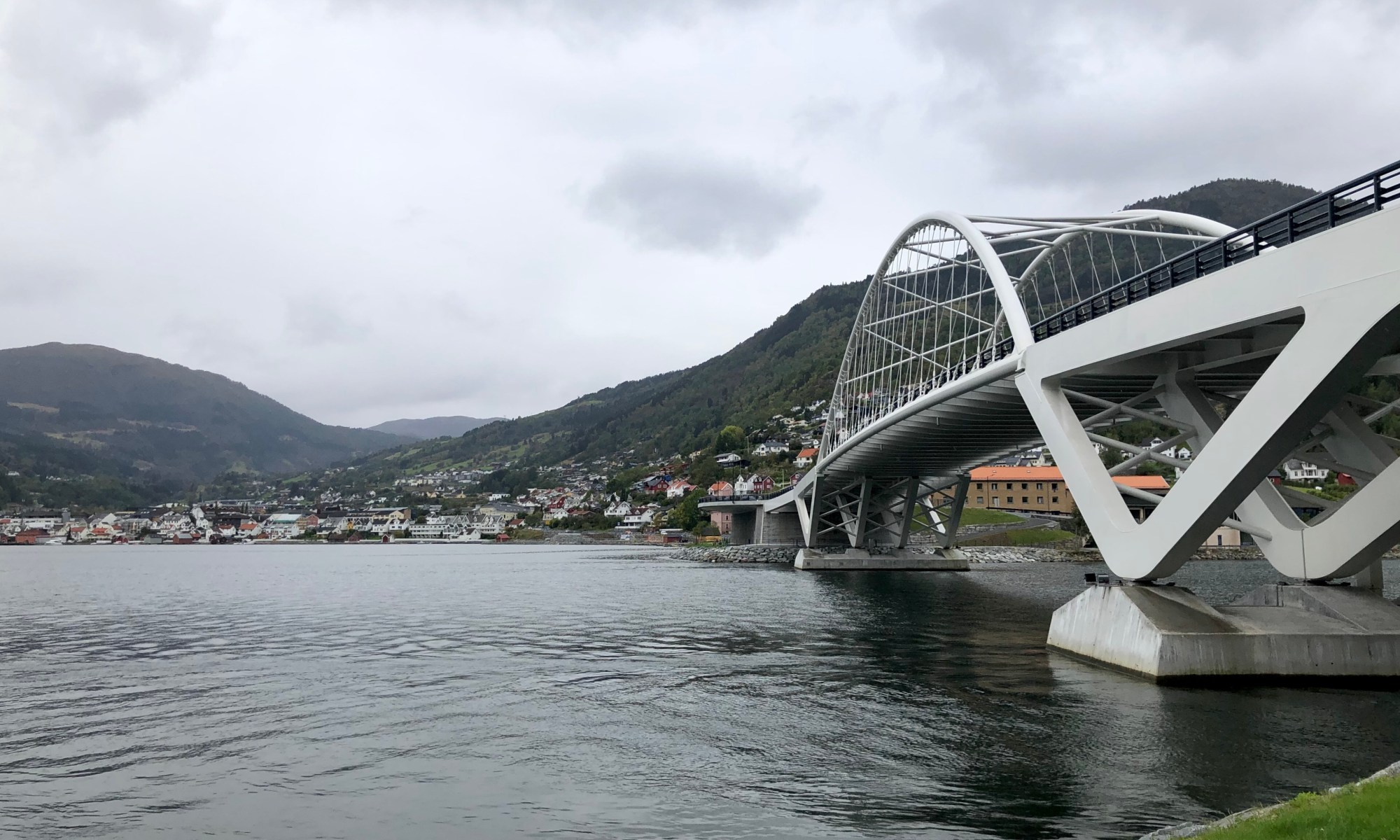
Today was another soaked day in Sogndal, though it appears it will likely be one of the last before we make our eventual exit in a week’s time. This led to something of an administrative day for us, completing a few last errands to sustain the rest of our stay, which was productive with respect to our ability to keep breakfast on the table, but not so conducive to the usual collection of pictures or grand tales to share. But I’ve taken the opportunity to assemble some miscellaneous thoughts that have rattled around in my head since our trip began but have never found a home in previous entries, whether for a lack of cohesion with the theme of the day or simply my temporary amnesia at the time of writing. Some are lighthearted, and some are serious, but all are informed by the many conversations and reflections I’ve undertaken during these last weeks.
On family:
- It’s a running joke in Sogndal (because it’s funny, not because it’s untrue) that my dad seems to know the family history and the names of everyone’s parents and children and cousins and whatever else better than the actual residents of Sogndal. This is more a factor of his monomania than it is their ignorance or disinterest.
- It has confused more than one cashier to hear us introduce ourselves as visitors from the United States, only to then hand over our credit cards bearing our last name that we share with a good chunk of the city. Most have kept their bemusement confined to their facial expressions, but some have inquired about the obvious connection.
- It has remained at the forefront of my mind this entire trip how lucky I am to have an experience where I learn any information at all about my ancestors, let alone so many heavily detailed and well researched specifics about them. Ours is a country built not only on violence and enslavement, but also the collateral horrors that accompany them: erased ancestry, stolen memories, and severed connections. Many people alive today don’t get to have this experience because the very possibility was taken from them. This trip has gifted me with the privilege of belonging to documented history. But it has also amplified my drive to activism on behalf of those who cannot share it.
On food:
- Sogndal is a bread, butter and cheese lover’s dream. It is unclear to me if they are actually as common as we’ve experienced them to be, or if we have encountered them with unusual frequency because of the nature of our visit and their prevalence as snacks to accompany afternoon conversation. In either event, as Wisconsin natives, we came well prepared.
- I was amused today to discover that the local Subway–literally the only whiff of American influence I’ve seen anywhere in Sogndal–is open until 3 a.m. on weekends. I can only assume it’s a popular late-night option for the city’s student population, but, as this city reminds me so strongly of Northfield, the quaint little Minnesota town that is home to my alma mater, it seems a hilarious discrepancy with the otherwise placid Sogndal.
- As has become clear by now, I am particularly interested in and observant of differences in coffee culture for both professional and recreational reasons. While the prevalence of coffee in Norway definitely rivals that in the United States, the particulars are very, very different. I haven’t encountered a single episode of anyone in Norway–not in Sogndal, nor in Oslo–carrying coffee around in a disposable to-go cup. That isn’t to say they don’t exist (I did see a couple Starbucks locations in Oslo, so I have to imagine they’re around), but I feel safe saying that the ubiquitous American image of an on-the-go professional with a cardboard-sleeved latte in hand is not emulated here.
On culture:
- I have never–not a single time–had to wait for a car to pass before crossing a road in Sogndal. The habit of stopping for pedestrians appears to be deeply ingrained in the local consciousness. This is fairly common behavior in the Midwest, but not in Washington, where drivers are usually more concerned with the speed with which they can navigate between two points rather than anyone else’s safe passage.
- I don’t have the necessary familiarity with Norwegian sociology to begin to form a hypothesis for the reasons for this, but I will simply make this observation: I have never been made to feel unsafe here when speaking about my same-sex partner. I have detected absolutely no discomfort or concealed animus from anyone we’ve spoken to, and that is not a norm to which I am accustomed. You might think this would be a welcome change, but in a strange way, it’s actually slightly unnerving. I’ve lived too long in the United States, and as a result, my defenses will always be up, my skepticism always on alert. This is a sad reality, but it is what it is.
On Americans:
- I am sure many have taken precautions not to offend us, perhaps not anticipating how open we are to criticisms directed at some of America’s less admirable qualities. But we have been able to glean several opinions that seem commonplace regarding the American way of life. Among them: Twinkies are not good, and we ought to reconsider our embrace of them as a national treasure; the Electoral College is a bafflingly inane construct; school lunches ought to appear better than the meals we serve our pets (many have been particularly stunned to learn that the reports regarding the food we serve our schoolchildren are actually true); and guns are tools, not weapons, meaning the response to gun violence should be to punish for the misuse of the tool and to increase education regarding the proper use of that tool, not to disseminate more guns to the general public in hopes that they, too, will misuse them. On this last point, they think we are actually out of our minds. Because we are.
- Related to the previous point, it’s been a refreshing affirmation of our sanity that many in Norway cannot understand why we treat certain things as political matters that have two legitimate sides. Guns are one. Prioritizing the welfare of the public is another. Paying proper respect to the environment, including taking tangible steps in its defense, is yet another. This is not to suggest that the country has achieved enlightenment and closed the case file on all of these problems. But it is telling how little time they spend here arguing over the general course of action in each case.
We did have the privilege of ending our evening with Geir, Marit, Arnor, Kari, Karl-Andre, Cathrine, Benjamin, Silje Marie, and Kristine, all of whom joined us for a meal at the local Chinese restaurant so that we could thank them for their generosity and warm welcome to Sogndal. I have truly come to love this family for their kindheartedness, their humor, and their spirit. We have made many of our best memories here with them, and mere words in a blog can’t thank them enough for all they have done and will continue to do for us in the coming days. But I offer them just the same. Thank you all so very much.
 Where the Waterfalls Mean Home